





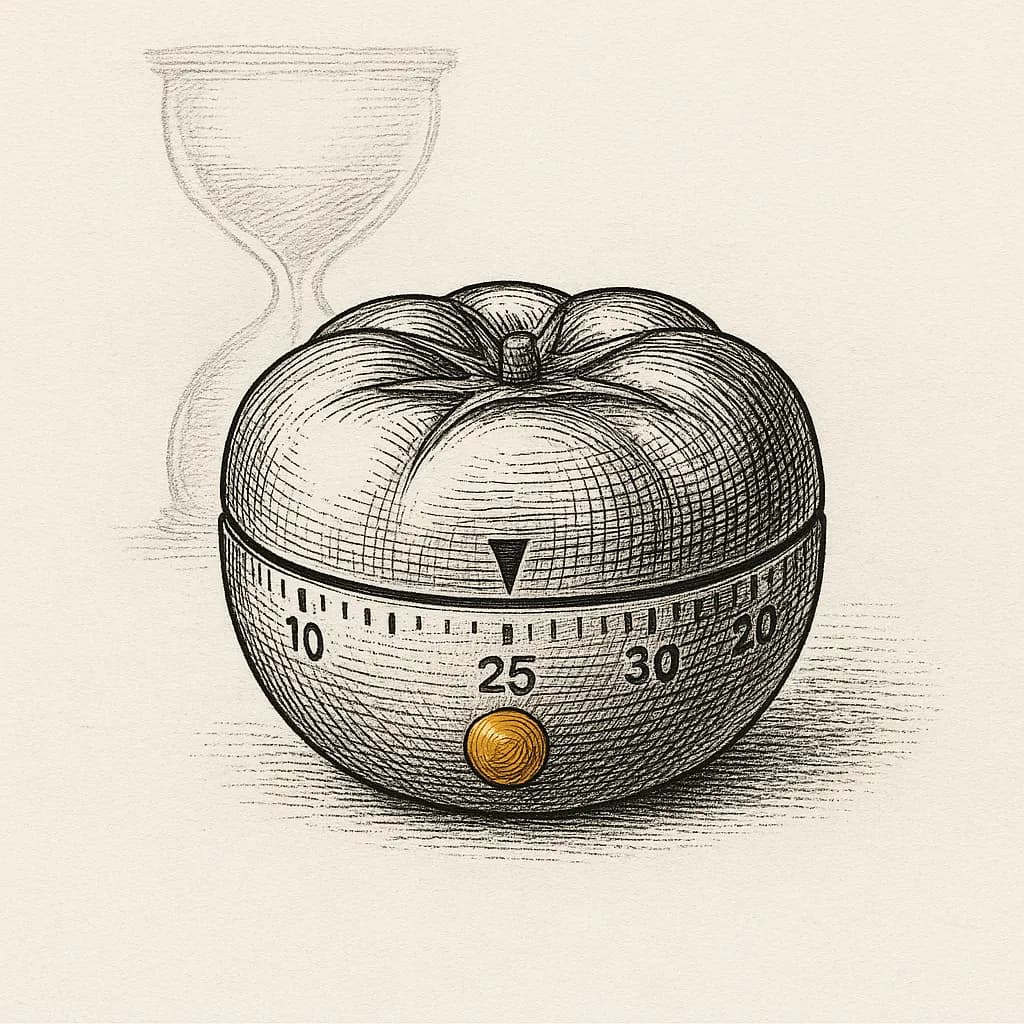
Conceptual Basis
The Pomodoro Technique is grounded in the neuroscience of sustained attention and mental fatigue. Dopaminergic signalling in the prefrontal cortex diminishes after roughly 20–30 minutes of concentrated effort, leading to diminishing returns. By introducing a brief respite, the technique resets neurochemical balance and preserves cognitive agility.
Standard Protocol
- Plan — Select a single, clearly defined task.
- Focus — Set a 25-minute countdown timer; work with complete immersion.
- Record — Mark the completion of one pomodoro on paper; micro-tracking boosts intrinsic motivation.
- Refresh — Take a 5-minute active break: stand, stretch, hydrate.
- Long Break — After four cycles, detach for 20–30 minutes.
Customization
- Task Complexity — For heavy analytical work, some practitioners favor 45/10 splits; creative drafting might prefer 15/3 sprints.
- Stacking — Combine Pomodoros with time-blocking: dedicate a two-hour block that automatically contains four pomodoros and breaks.
Measuring Effectiveness
Track output units per pomodoro over a week. An upward trend indicates improved efficiency, while plateaus may suggest timer anxiety or task switching leaks.
Integration with Technology
Browser extensions can auto-mute notifications and lock distracting sites during focus intervals, reinforcing an environment of deep work.
Limitations
Rigid timers can fracture flow states in tasks requiring extended immersion (e.g., coding architecture). Use longer spans or "soft" pomodoros when needed.
Bottom Line
The Pomodoro Technique operationalizes the abstract concept of focus into tangible intervals, offering a sustainable path to prolonged productivity without cognitive burnout.